Nine Domains, Finite Man
A complete life does not require nine simultaneous summits. One seasonal summit, eight protected floors, a named cost and a date to look again.
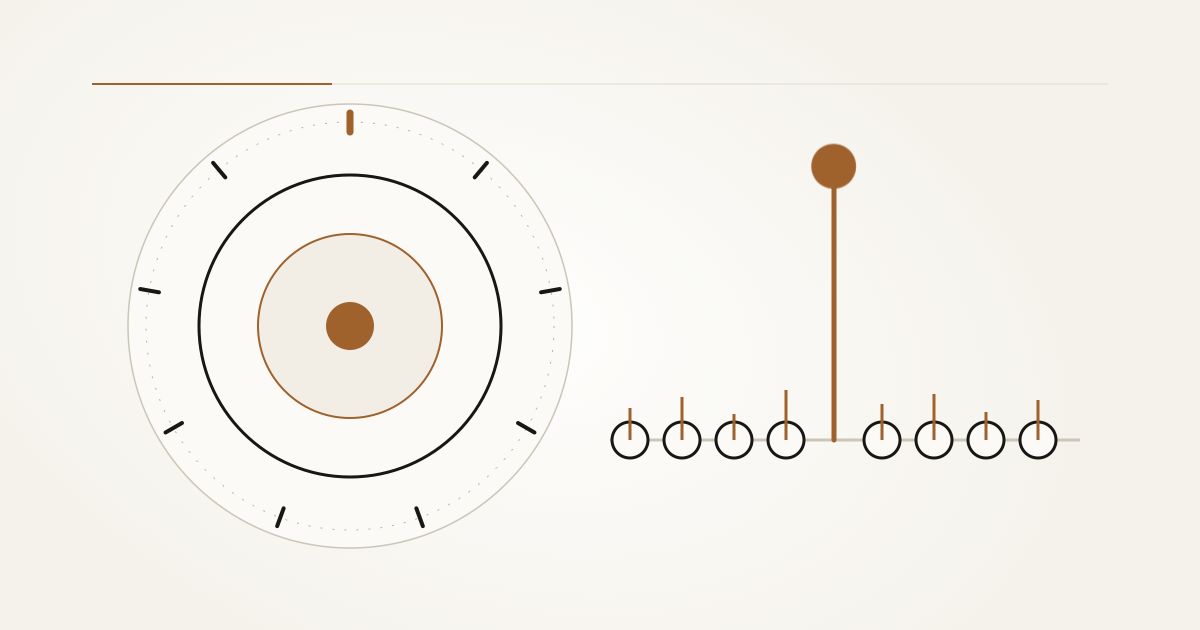
How do you carry nine domains at once? You do not. A complete life is one seasonal summit and eight protected floors: choose where growth matters now, decide what must not collapse elsewhere, name who bears the trade-off, and set a date to look again.
Nine Rites asks a man to face nine domains at once: self-command, body, attention, fatherhood, money, brotherhood, repair, purpose and mortality.
That can sound like an instruction to improve everything simultaneously.
It is not.
No finite man can push nine fronts forward with equal force. Time given to a young child cannot also be spent building a company. A difficult repair can consume the attention that training normally receives. Illness, grief, care, financial strain and meaningful work all create seasons in which one obligation becomes unusually heavy.
The fantasy is not that trade-offs can be avoided. The fantasy is that they can remain unnamed without becoming consequences.
Nine obligations are not nine projects
Oliver Burkeman's work on finitude offers a useful test for any system of self-improvement: does it help you neglect the right things?
The source route is explicit: Four Thousand Weeks Source Map holds the complete owned-copy pass; Wiki Oliver Burkeman supplies the wider synthesis; the verified short-language record holds attribution cautions; and Kp 010 Oliver Burkeman Finitude And Strategic Neglect Protocol carries the general-purpose application. This article develops a Nine Rites synthesis from those sources rather than presenting its summit-and-floors model as Burkeman's own protocol.
That question belongs inside Nine Rites, not outside it. A framework of nine domains becomes dishonest if it implies that every domain can be maximised at once. Yet the opposite claim is also dishonest. "I am focused on work this year" does not make absence from family, health, money or repair strategically wise.
The answer is neither balance nor obsession.
It is a seasonal summit with protected floors.
The summit is the domain receiving deliberate growth in this season. It gets the extra hours, attention, discomfort and ambition. It is the place where you are trying to become more capable rather than merely remain functional.
A floor is the minimum standard below which another domain must not fall. It is not excellence. It is the conduct that prevents temporary underinvestment from becoming damage.
Debt is what accumulates when a floor is repeatedly breached. Health debt appears as exhausted capacity. Money debt becomes interest and narrowing options. Repair debt becomes mistrust. Fatherhood debt appears in moments that cannot be recreated later. Some debts can be repaid. Some can only be regretted.
This distinction permits unequal effort without pretending that neglected obligations disappear.
Choose one summit
A summit should be specific enough to organise a season.
"Purpose" is too broad. Completing a difficult body of work, changing direction in a career, caring for a parent well, rebuilding physical capacity or becoming reliably present during a child's transition can each serve as a summit.
The summit is not necessarily the most impressive domain. It is the obligation that deserves disproportionate attention now.
That may mean six months of building a business. It may mean three months of rehabilitation. It may mean a season in which repair takes precedence over achievement because a relationship has been damaged by your conduct. It may mean reducing ambition elsewhere while a baby is small.
A summit is chosen. An obsession merely takes over.
Protect the other eight floors
Once the summit is named, define a floor for every other domain.
The floor should describe observable conduct:
- Self-command: keep the two promises that protect the rest of the week.
- Physical proof: train twice, sleep before the late work becomes habitual, and act on pain rather than performing through it.
- Digital sovereignty: keep the phone away from meals and the first conversation at home.
- Father presence: protect one undistracted daily ritual and keep promises made to your children.
- Money truth: know the current position, cover due obligations, and communicate trouble before someone has to chase you.
- Brotherhood: make one honest contact rather than disappearing until life becomes easier.
- Repair: return to harm promptly; do not let busyness become immunity from apology.
- Purpose through service: keep one act of useful craft alive even when it is not the summit.
- Mortality reset: retain one practice that reminds you which urgency is real.
These are examples, not a universal prescription. A floor must fit the man's real obligations, capacity and household. Its purpose is to make neglect visible before consequences make it undeniable.
Some floors are more load-bearing than others. Children still need care during a career sprint. Bodies still require sleep during a launch. Debts still come due during grief. Trust still decays when repair is postponed. A finite man may reduce attention to these domains; he cannot responsibly reduce them to zero.
Name who carries the cost
Calling a trade-off strategic does not make it private.
The extra hours at work may be carried by a partner doing more at home. The training block may narrow family time. Avoiding a financial conversation may transfer uncertainty to everyone who depends on the account. Delayed repair may grant you relief while another person carries the injury.
Other people do not automatically consent to subsidise your summit.
Before declaring a season of focus, ask:
- Who gains if this goes well?
- Who carries more because of it?
- What have I promised them?
- Have I told them what will be reduced and for how long?
- What would they say I am calling "temporary"?
Communication does not settle every trade-off. It does prevent a unilateral decision from masquerading as shared purpose.
Put an end date on neglect
Named neglect without a review date soon becomes drift with better vocabulary.
A season should close on a date or event: the launch, the examination, the first twelve weeks of recovery, the end of the quarter, the child's return to school. At that point, reassess all nine domains. Do not ask only whether the summit advanced. Ask what the climb cost.
Did a floor hold? Was it badly chosen? Did another person absorb more than agreed? Has temporary underattention become debt? Does the same summit still deserve the next season?
A hole you have named and dated is a trade-off. A hole you refuse to inspect is the thing that widens.
The nine-domain review
Use one page.
- Name the summit. Which single domain receives deliberate growth this season, and what would real progress look like?
- Set eight floors. Write one observable minimum for every other domain.
- Name the cost-bearers. Who is affected by each reduction, and what conversation or agreement is required?
- Set the review date. Choose when all nine domains will be examined again.
- Repair breached floors now. If trust, health, money, children or legal duties are already carrying the cost, do not dignify the breach as strategy. Act.
The point is not to produce a perfectly balanced life. Perfect balance is another form of refusing to choose.
The point is to direct finite effort without becoming a stranger to the obligations that make a life whole.
Nine domains. Finite man. One summit. Eight floors. No invisible debt.
Your life does not need another insight. It needs a threshold.
Join the waitlist for future Nine Rites pilot updates. No programme is currently open for enrolment.
Join the waitlist →Not ready? Start with the free 7-Day Practice.